




Metal wall panel roll forming machines allow roofing contractors, siding installers and metal fabricators to produce finished wall panels directly from sheet metal coil. Instead of buying pre-cut panels, a manufacturer can form different profiles, set the required panel length and produce material as needed.
In this article, wall panels means formed metal wall cladding and siding panels made from steel, aluminum or other sheet metal coil. These are different from PVC, WPC, 3D decorative, concrete or precast wall panel production equipment.
What Is a Metal Wall Panel Roll Forming Machine?
A metal wall panel roll forming machine continuously shapes flat sheet metal into a finished profile. The material starts as a coil, passes through forming stations and leaves the machine as a wall or siding panel cut to the required length.
Depending on the tooling configuration, the same production system can be used for more than one profile. This is important for contractors and fabricators that produce different types of exterior metal cladding instead of manufacturing only one standard panel.
What Types of Metal Wall Panels Can Be Produced?
The term “wall panel” covers several different metal cladding profiles. The exact profiles available depend on the tooling installed on the roll forming machine.
Flush Wall Panels
Flush wall panels have a relatively flat appearance and are commonly used for commercial, industrial and architectural wall cladding. They provide a clean exterior surface without the deep ribs found on many traditional siding profiles.
Metal Siding
Roll-formed metal siding can be produced in different profiles depending on the building design and tooling. Metal siding is used on commercial buildings, agricultural structures, workshops and residential projects.
Standing Seam Wall Panels
Standing seam profiles can be used for wall applications as well as roofing. Mechanical and snap-lock configurations are available depending on the tooling and project requirements.
Board & Batten Siding
Board and batten-style metal siding creates a vertical architectural appearance and can be produced from coil using dedicated forming tooling.
Custom Metal Wall Panels
Custom tooling can be developed for projects that require a specific architectural or commercial panel profile rather than a standard product.
How Metal Wall Panel Production Works
The basic production process is straightforward. A coil is loaded onto a reel or decoiler, the sheet enters the forming section and the machine progressively shapes the material into the selected profile.
Roll forming is designed for continuous production. Once the coil and tooling are set up, the machine can produce a sequence of panels at programmed lengths without manually measuring and forming every individual sheet.
Automatic Pre-Notching for Metal Wall and Roof Panels
Some panel profiles require notches at the ends of the sheet before the final legs or seams are formed. On a machine equipped with automatic pre-notching, these cuts can be made during the production cycle.
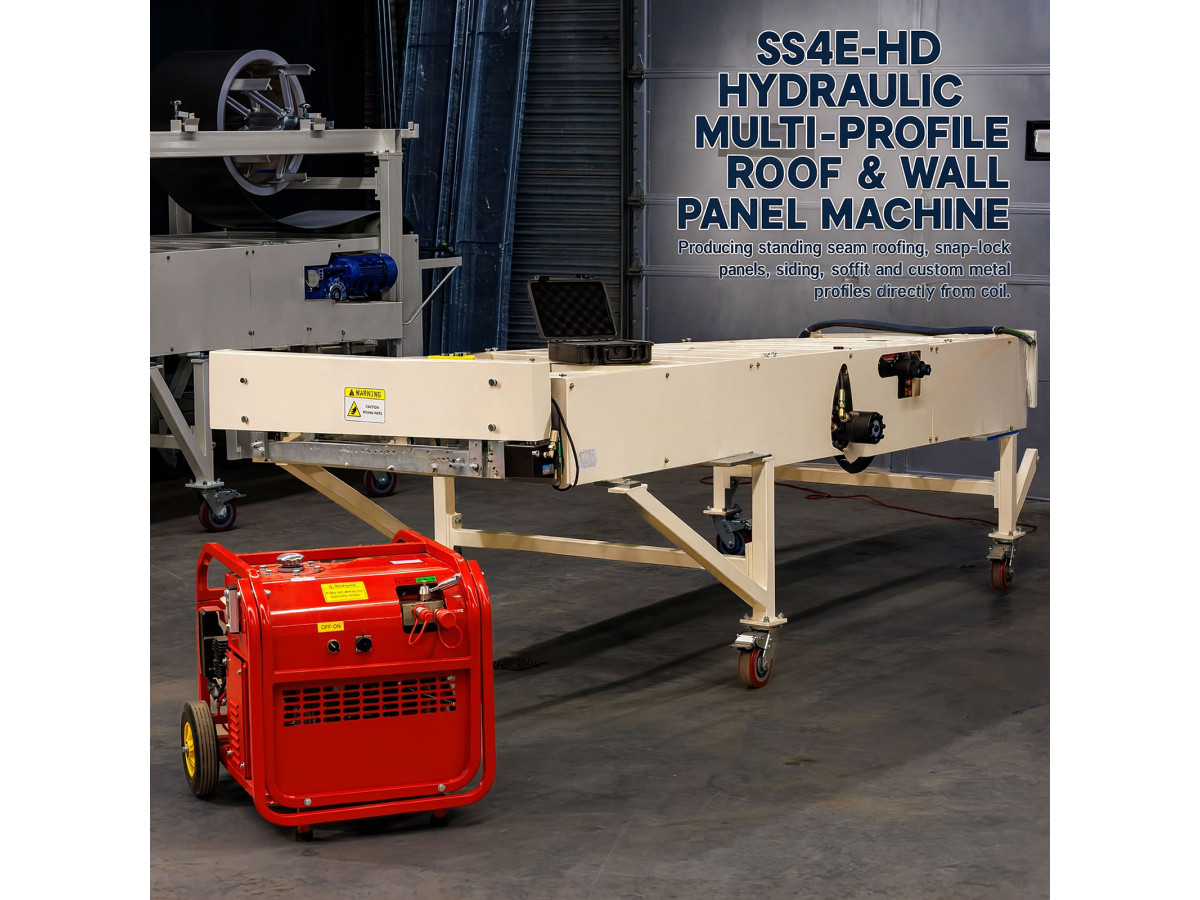
The SS4E-HD, for example, uses automatic hydraulic pre-notching to create rectangular notches at both ends of the panel before the profile is fully formed. The process leaves a flat tab and allows the hydraulic exit shear to cut the remaining flat section.
Automatic notching can reduce the amount of manual cutting required after roll forming, which is particularly useful when producing large quantities of panels or when consistent end geometry is important.
What Materials Can Be Used?
The material range depends on the roll former configuration and selected profile. A production machine for metal wall panels may be configured for several common architectural and construction metals.
| Material | Typical application | Important consideration |
|---|---|---|
| Pre-painted steel | Wall panels, siding and roofing | Gauge and coating must match the selected profile |
| Galvanized steel | Industrial and commercial cladding | Thickness and material strength affect forming requirements |
| Galvalume | Roofing and wall applications | Suitable tooling and machine setup are required |
| Aluminum | Lightweight architectural panels and siding | Different forming characteristics require appropriate tooling |
| Copper | Specialty architectural applications | Requires configuration suitable for copper material |
Metal Wall Panels vs. Other Wall Panel Machines
Not every search for a “wall panel machine” refers to the same type of equipment. The manufacturing technology depends entirely on the material and finished product.
| Machine type | Material | Typical product | Technology |
|---|---|---|---|
| Metal wall panel roll forming machine | Steel, aluminum, Galvalume | Wall cladding, siding, architectural panels | Roll forming |
| Metal siding roll forming machine | Coil sheet metal | Metal siding | Roll forming |
| PVC wall panel production equipment | PVC | Interior decorative panels | Extrusion |
| WPC panel production equipment | Wood-plastic composite | Decorative wall panels | Extrusion / molding |
| Precast wall panel equipment | Concrete | Structural or architectural concrete panels | Concrete casting |
For roofing contractors, metal building contractors and sheet metal manufacturers, the relevant search category is the metal wall panel roll forming machine, not PVC, WPC or precast wall panel equipment.
Can One Machine Produce Different Wall Panel Profiles?
Yes, when the machine is designed with interchangeable tooling. This is one of the main advantages of a multi-profile roll forming system.
For a contractor or manufacturer, this can be more practical than purchasing a separate machine for every profile. The machine can be configured for one product and later equipped with additional tooling for another profile, subject to the machine's capabilities.
Flush Wall Panel
For clean, relatively flat commercial and architectural wall surfaces.
Board & Batten
For vertical architectural siding applications.
Standing Seam
For applications requiring concealed seams and a continuous architectural appearance.
Custom Profile
For manufacturers producing proprietary or project-specific metal panels.
Producing Wall Panels at the Job Site
A mobile roll forming machine changes the economics of panel production for some contractors. Instead of transporting long finished panels from a factory to the job site, the contractor can transport the machine and coil and produce panels where they are needed.
For permanent manufacturing facilities, the same concept can be installed in a workshop or production area and connected to an appropriate material handling and coil feeding setup.
Why Produce Metal Wall Panels from Coil?
How Much Does a Metal Wall Panel Roll Forming Machine Cost?
The price depends heavily on the machine configuration. A basic electric roll former with one profile is not directly comparable with a hydraulic multi-profile machine equipped with automatic notching, PLC controls and mobile-production equipment.
SS4E-HD Hydraulic Multi-Profile Machine
Current listed price for the SS4E-HD hydraulic multi-profile roof and wall panel roll forming machine. The machine is designed for multiple metal roofing and wall panel profiles and is available with hydraulic forming, automatic pre-notching and automated cutting functions.
| Machine | Listed price | General positioning |
|---|---|---|
| SS4E-HD | $77,800 | Hydraulic multi-profile production, automatic notching and cutting |
| SS4E-PRO | $40,750 | Portable electric multi-profile production |
| SS4E-15 | $19,000 | More compact and lower-cost roll forming configuration |
What to Look for When Buying a Wall Panel Roll Forming Machine
Before buying a metal wall panel machine, focus on the actual profiles and materials you plan to produce rather than choosing a machine only by its advertised production speed.
- Profile range: Check whether the machine supports the wall panel and siding profiles you need.
- Tooling: Find out which tooling is included and what additional profiles can be added.
- Material range: Confirm compatible steel, aluminum, Galvalume or copper thicknesses.
- Cutting system: Compare manual, electric and hydraulic cutting options.
- Notching: Determine whether automatic pre-notching is required for your profiles.
- Controls: PLC controls are useful when the production process requires repeatable panel lengths and quantities.
- Power: Check whether the machine is electric, hydraulic, gas-powered or available with different power configurations.
- Mobility: If panels will be produced on construction sites, consider trailer mounting, coil handling and reel systems.
- Support and parts: Ask about replacement parts, technical support and warranty before purchasing.
SS4E-HD Hydraulic Metal Wall Panel Roll Forming Machine
The SS4E-HD is a heavy-duty multi-profile roll forming machine designed to produce roofing and wall panel profiles from metal coil. Its configuration is aimed at contractors and manufacturers that need more automation and production capability than a basic portable roll former.
Typical SS4E-HD Wall Panel Applications
Commercial Buildings
Metal wall cladding and architectural panels for commercial structures.
Metal Building Contractors
On-site or shop production of wall panels for building projects.
Panel Manufacturers
Production of multiple panel profiles from coil for distribution or project work.
Roofing & Siding Contractors
One multi-profile machine can support both roofing and wall-panel production when the appropriate tooling is installed.
Wall Panel Machine or Complete Production Line?
These terms should not be confused. A wall panel roll forming machine is the forming machine itself. A complete production line may include coil storage, decoiling, leveling, feeding, roll forming, cutting, stacking and additional automation.
For many contractors, a standalone roll former with the appropriate coil handling equipment is enough. Larger manufacturing operations may require a more extensive automated production line.
For a manufacturer: prioritize production capacity, automation, tooling options, material handling and repeatability.
Is a Metal Wall Panel Roll Former Right for Your Business?
A roll forming machine makes sense when metal wall panels are a regular part of your business rather than an occasional requirement. The investment becomes easier to justify when the machine can produce several profiles and when the company has consistent demand for custom-length panels.
For a business producing both roofing and wall products, a multi-profile machine can also provide more flexibility than equipment dedicated to a single panel type.
Looking for a Metal Wall Panel Roll Forming Machine?
The SS4E-HD is designed for hydraulic multi-profile production of metal roofing and wall panels from coil. Contact StanGroup to discuss available tooling, panel profiles, material specifications and machine configuration for your production requirements.
View SS4E-HD Machine