

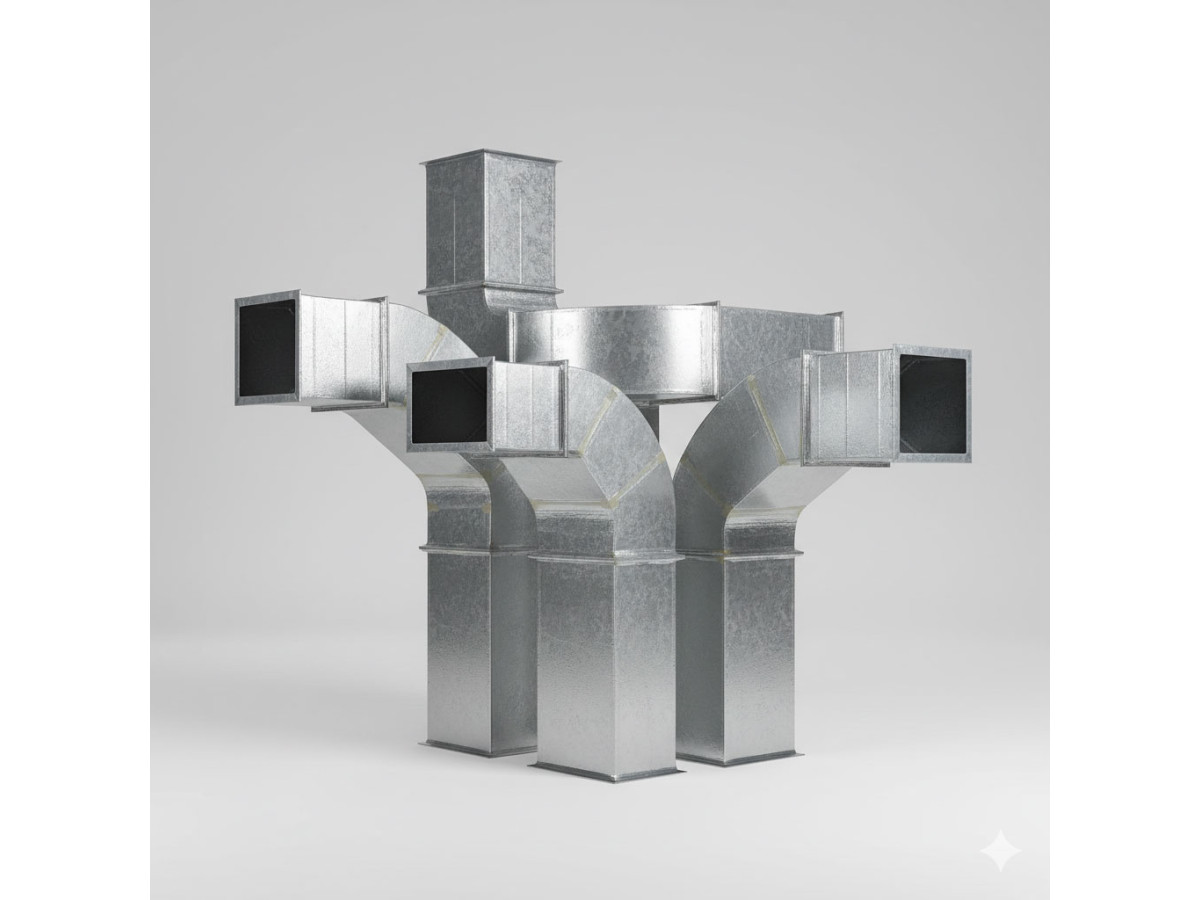
If you look at a finished square air duct installed in a building, it seems like a simple metal box. But once you open the production process, it becomes clear that even a basic duct is the result of several precise operations — cutting, reinforcing, forming locks, bending, and assembling. Each step is handled by a specific machine, and the quality of airflow in the system depends directly on how accurately these operations are done.
In small and medium HVAC workshops, production is not fully automated. Instead, it is based on a set of standalone machines that handle different stages of fabrication. Below is a practical breakdown of how square ducts are made and which equipment is typically used.
1. Sheet Metal Cutting – Starting Point of Every Duct
The process begins with galvanized steel sheets or coils, usually in the range of 0.5–1.2 mm thickness (18–26 gauge). The material must be cut into precise dimensions before any forming begins.
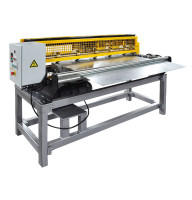
Manual slitter and cut-to-length machine
In many workshops, a manual slitter and cut-to-length machine is used. It allows both longitudinal cutting (slitting) and cross cutting into required sheet sizes. This stage determines the accuracy of the entire duct section, because even a small deviation here affects all later steps.
- Typical sheet width: 1000–1300 mm
- Material: galvanized steel, aluminum
- Accuracy: depends on operator skill (usually ±1–2 mm)
machine product link Manual slitter and cut to length
2. Sheet Reinforcement – Beading Process
Flat metal panels are not strong enough for duct applications, especially when airflow pressure is involved. To increase rigidity, reinforcement ribs are formed across the sheet surface.
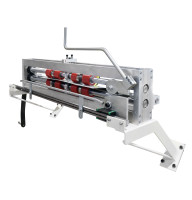
HVAC duct beading machine (60” industrial type)
A duct beading machine presses 5–7 parallel ribs into the sheet. These ribs prevent vibration, reduce deformation, and improve structural stability without increasing material thickness.
This step is especially important for large ducts used in ventilation shafts, industrial halls, and long distribution lines where panel deflection is a common issue.
machine product link Duct Beader
3. Lock Formation – Pittsburgh Lock Machine
Once the sheet is reinforced, edges are prepared for joining. The most common method is the Pittsburgh lock, which creates a strong mechanical seam along the duct length.
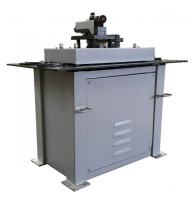
Pittsburgh lock-forming machine
This machine shapes different edge profiles used in HVAC fabrication, including Pittsburgh locks, hems, and standing seams. The lock ensures that the duct can be closed tightly without welding or complex fastening.
- Material thickness: 22–26 gauge
- Common use: longitudinal duct seam
- Output speed: ~10–12 m/min
In practice, this is one of the most critical machines because poor lock alignment can lead to air leakage in the finished system.
machine product link Pittsburgh Lockformer
4. Flange Production – TDF/TDC Roll Forming Machine
Instead of traditional frame-based connections, modern HVAC ducts often use TDF or TDC flanges formed directly on the sheet edges.
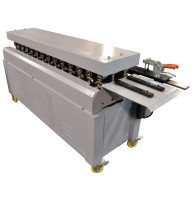
TDFC / TDCF lock & cleats roll-former
This machine gradually shapes the edge of the duct through multiple forming stages. It creates standardized flanges and cleats that are compatible with corner fixing systems.
It also helps reduce manual labor by replacing separate flange fabrication steps with a single forming process.
- Material thickness: 18–24 gauge
- Speed: ~45 ft/min
- Function: flange + cleat forming
machine product link TDFC TDCF rollformer
5. Bending – Pneumatic Duct Brake Machine
After edges are prepared, the flat sheet is bent into a rectangular shape. This is done using a pneumatic HVAC brake designed specifically for ductwork geometry.
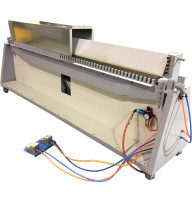
Pneumatic TDFC sheet metal brake
The machine bends metal from 0° to 120° with consistent pressure across the sheet. Unlike universal press brakes, it is optimized for repetitive duct dimensions and fast operation without frequent adjustments.
It is commonly used for straight duct sections and standard fittings.
machine product link Duct Brake Machine
6. Corner Assembly – Corner Fixing Machine
After bending and flange forming, the final step is installing corners that lock the duct structure together.
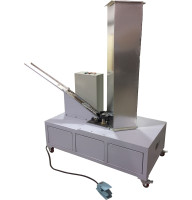
This pneumatic machine inserts and presses corner pieces into TDF/TDC flanges. The process is fast, usually taking only a few seconds per corner, and ensures consistent mechanical strength across all joints.
It significantly reduces manual hammering and improves assembly repeatability.
machine product link TDFC Corner Fixing Machine
Comparison of Key Machines Used in Square Duct Fabrication
| Production Stage | Machine | Main Function |
|---|---|---|
| Cutting | Manual slitter / cut-to-length machine | Sheet sizing and preparation |
| Reinforcement | Duct beading machine | Adding structural ribs |
| Seam forming | Pittsburgh lock-former | Creating longitudinal lock |
| Flange forming | TDF/TDC roll-former | Edge flange and cleat production |
| Bending | Pneumatic duct brake | Forming rectangular shape |
| Assembly | Corner fixing machine | Installing corner joints |
Practical tips from workshop experience
In real production environments, the quality of the duct depends more on consistency than speed. For example, if beading depth is uneven, the panel may vibrate once installed in long ventilation shafts. Similarly, incorrect Pittsburgh lock pressure can create micro-gaps that later cause air leakage.
Another important detail is material flow between machines. Even in small workshops, organizing workstations in a logical order reduces handling time and improves output without needing full automation.
Operators often adjust machine settings depending on duct size — thinner sheets require lighter pressure during locking, while larger ducts need deeper flange reinforcement to maintain rigidity.
FAQ
What thickness of metal is commonly used for square ducts?
Usually 0.5–1.2 mm galvanized steel depending on duct size and airflow pressure.
Do all ducts require Pittsburgh locks?
Most rectangular ducts use Pittsburgh locks for longitudinal seams, although some systems rely more on TDF/TDC connections.
Why are ribs (beading) necessary?
They prevent panel vibration and deformation, especially in large or high-pressure ducts.
Is TDF better than traditional frame connections?
TDF/TDC systems are widely used because they reduce assembly time and improve sealing consistency, but traditional methods are still used in some cases.
Square duct manufacturing is not about one complex machine — it is about a set of specialized tools working step by step. Each machine handles a specific function, and the final quality depends on how well these operations are aligned in practice.
Equipment for the production of square air ducts can be viewed in the website section HVAC Square Duct-work Machinery
If you are planning to equip a workshop for HVAC duct fabrication, choosing compatible machines for cutting, beading, locking, bending, and corner assembly is the key to stable and predictable production results.