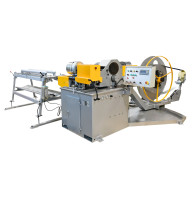


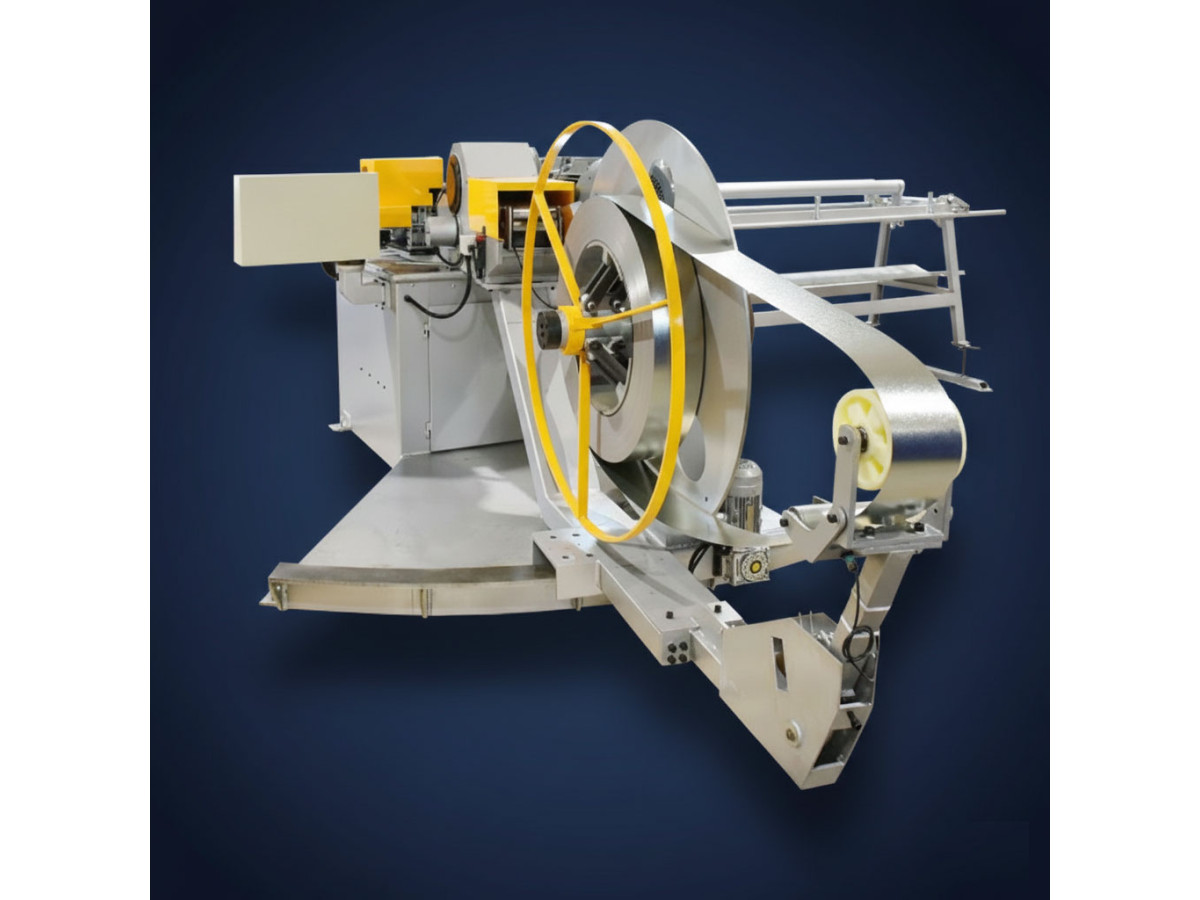
Imagine a production line capable of delivering hundreds of meters of perfectly shaped round ducts per shift, with diameters ranging from 80 to 2500 mm — no manual alignment, no deformation, and minimal metal waste. This is exactly what a modern industrial spiral tube forming machine delivers, and in 2026 it is no longer an advantage — it is a standard for HVAC manufacturing.
A few years ago, many workshops still relied on semi-automatic equipment, but the market is now rapidly shifting toward full automation: PLC control systems, servo cutting units, automatic coil feeding, and stable seam formation. All of this directly impacts production cost and delivery speed.
How an industrial spiral tube forming machine works in real production
In practice, the process is much simpler than it seems. A steel strip (usually galvanized steel 0.4–1.2 mm) is fed into the forming section, where it is spirally wound at a precise angle. The seam is automatically locked using a mechanical interlock system.
In modern machines — such as equipment similar to StanGroup or European equivalents — forming speed reaches 30–50 m/min, allowing manufacturers to fulfill large orders without production bottlenecks.
Key components that directly affect product quality
- automatic strip feeding and alignment system
- adjustable forming rollers with angle control
- PLC controller with diameter memory storage
- automatic cutting system (plasma or disc blade)
- diameter calibration station
Field experience shows that most defects are not caused by the machine itself but by incorrect strip tension settings. That is why operators always calibrate feed balance before starting production batches.
Why spiral tube forming machines are replacing traditional methods
The difference becomes obvious in production costs. Traditional round duct manufacturing requires more welding and manual work, while automated lines reduce material waste by approximately 8–12%.
Another key advantage is dimensional stability. For HVAC systems, this is critical: even a 2–3 mm deviation can affect airflow pressure losses across the system.
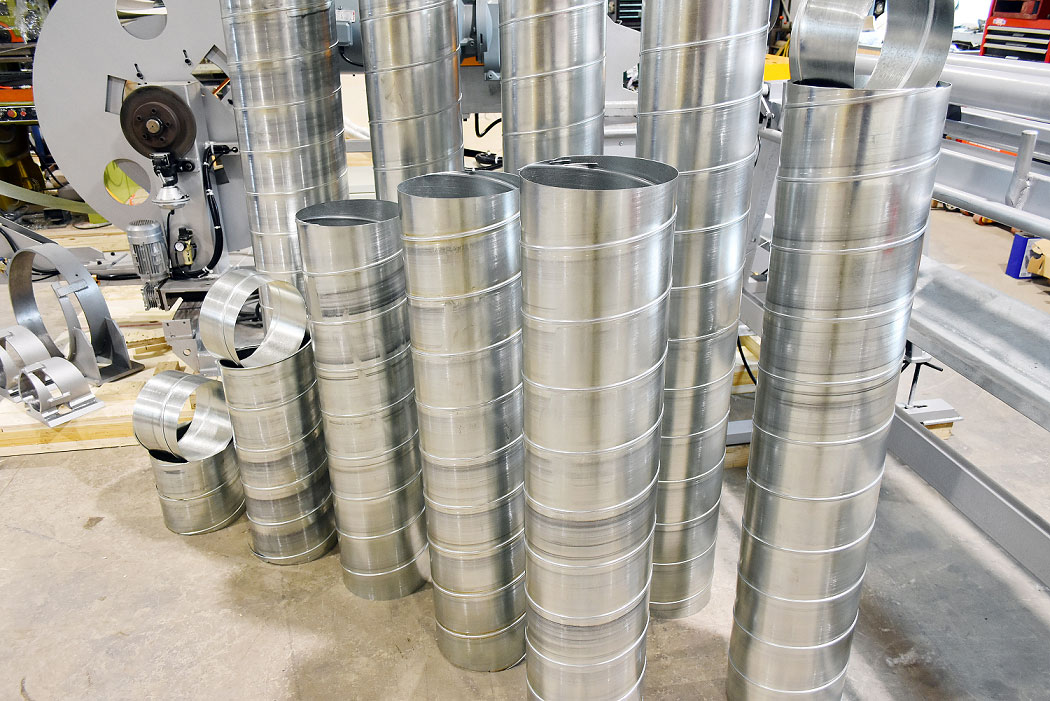
Where this difference matters most
- large HVAC projects (shopping malls, industrial plants)
- industrial ventilation systems
- long-distance duct distribution networks
Comparison of duct production technologies
| Parameter | Manual production | Spiral tube forming machine |
|---|---|---|
| Speed | 5–10 m/min | 30–50 m/min |
| Material waste | 10–15% | 2–5% |
| Diameter accuracy | ±5 mm | ±1–2 mm |
| Operator dependency | High | Low |
Practical tips for choosing equipment in 2026
Most purchasing mistakes are not related to brand selection but to incorrect specification of diameter range and sheet thickness. For example, if the production is focused on industrial ventilation systems, it is better to choose a model supporting up to 2000–2500 mm diameter from the start.
Another important factor is the cutting system. Plasma cutting offers flexibility, while disc cutting provides cleaner edges and reduces post-processing time. In large-scale production, this can save 2–3 hours per shift.
PLC system stability is also critical. Modern machines store 100–200 diameter presets, significantly reducing setup time between production runs.
FAQ
What sheet thickness can be processed?
Typically 0.4–1.2 mm for galvanized steel, and up to 1.5 mm in reinforced models.
Is operator training complicated?
Basic training takes 2–3 days since most operations are automated.
What is the average productivity?
Industrial models can produce up to 8–12 tons of finished ducts per shift.
Can it be integrated into a production line?
Yes, most modern spiral tubeformer machines support integration with coil feeding and cutting systems.
What is the service life of the machine?
With proper maintenance, 8–12 years of stable operation is typical.
Looking at the modern HVAC market, it becomes clear that manufacturers who adopt automated spiral tube forming machine systems gain not just speed, but a real competitive advantage in production cost per meter of duct.
To achieve stable quality, precise geometry, and real production cost reduction — investing in modern industrial spiral duct forming systems is the right step forward.
Round duct manufacturing equipment – view here